Waiting to Govern Your AI Isn't a Strategy — It's a Liability
Many organizations still approach AI governance as a documentation exercise.
Policies are written.
Committees are established.
Risk assessments are completed.
Audit trails are maintained.
And yet, when a regulator, auditor, board member, customer, or legal team asks a deceptively simple question—
"Why was this decision allowed to occur?"
—the answer often requires weeks of reconstruction across emails, tickets, logs, workflow systems, model platforms, and multiple teams.
The uncomfortable reality is this:
An AI system can have approved policies, pass internal audits, and maintain complete logs—and still execute decisions that would not be considered legitimate under current conditions.
The EU AI Act has accelerated this shift, but the underlying issue extends far beyond Europe.
Regulators are increasingly interested in more than policy existence.
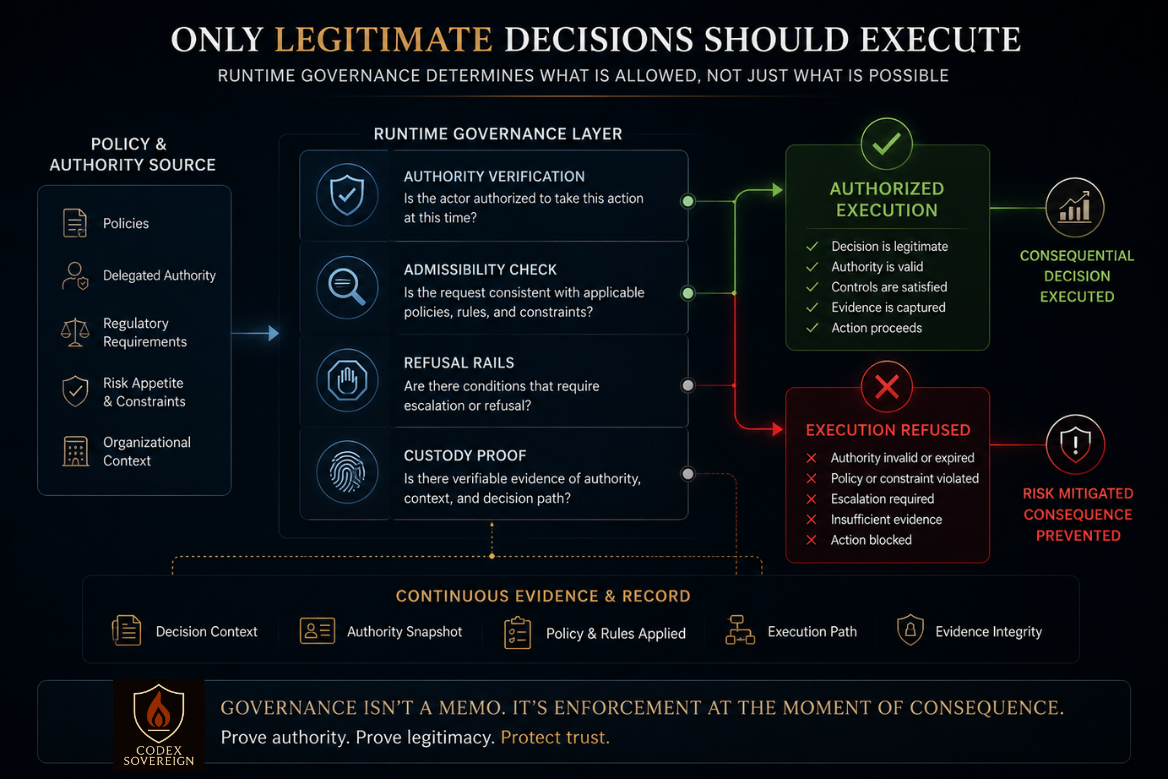
They want evidence that governance was actually enforced at the moment a consequential decision occurred.
Questions such as:
- Who authorized this action?
- Under what authority?
- Was that authority still valid at execution time?
- What evidence supported continuation?
- Which controls were active?
- Was human oversight required?
- Can the decision path be reconstructed and defended?
These are no longer theoretical questions.
They are operational questions.
Decision Evidence Is Becoming Critical Infrastructure
As organizations deploy increasingly autonomous and agentic systems, decision evidence is evolving from a compliance artifact into critical trust infrastructure.
When organizations cannot reconstruct consequential decisions, the consequences extend well beyond audit findings.
Organizations may experience:
- regulatory scrutiny and remediation requirements;
- increased legal exposure;
- prolonged incident investigations;
- delayed business initiatives;
- executive and board escalation;
- loss of stakeholder confidence;
- and costly governance programs implemented under externally imposed deadlines.
The greatest risk is often not the incident itself.
It is the inability to demonstrate institutional control over the decisions that produced it.
The 60-Day Executive Governance Audit
The Codex Sovereign 60-Day Executive Governance Audit was designed to provide executive leadership with a clear view of their actual runtime governance posture.
Importantly, the audit does not require 60 days of executive involvement.
The sixty-day period reflects the assessment window needed to evaluate governance across people, processes, systems, workflows, and evidence chains.
Most executive participation is concentrated in a limited number of interviews, workshops, and review sessions.
The assessment primarily leverages:
- existing governance documentation;
- current policies and controls;
- workflow and process reviews;
- stakeholder interviews;
- evidence and audit artifacts;
- operational procedures;
- and runtime decision pathways.
The outcome is board-ready visibility into areas such as:
- runtime governance maturity;
- authority and accountability structures;
- admissibility and continuation controls;
- refusal and escalation mechanisms;
- custody and evidence integrity;
- decision traceability;
- and overall regulatory defensibility.
Governance Is Not a Memo
Policies narrate control.
Runtime governance enforces it.
As AI systems become increasingly autonomous, organizations that can continuously prove authority, accountability, and legitimacy at the moment consequence is created will likely be better positioned to scale responsibly and respond confidently under scrutiny.
If your organization is preparing for increased regulatory oversight or seeking greater confidence in its AI governance posture, I'd be happy to share a sample framework.
Learn more at: https://codexsovereign.org/sample-60-day-audit