
ARAS™ — Agentic Reentry & Admissibility Standard
Continuity ≠ Legitimacy
Every reentry point must independently re-establish admissibility.
ARAS governs autonomous and agentic systems across resets, handoffs, and reentry boundaries through runtime admissibility, refusal enforcement, and custody controls.
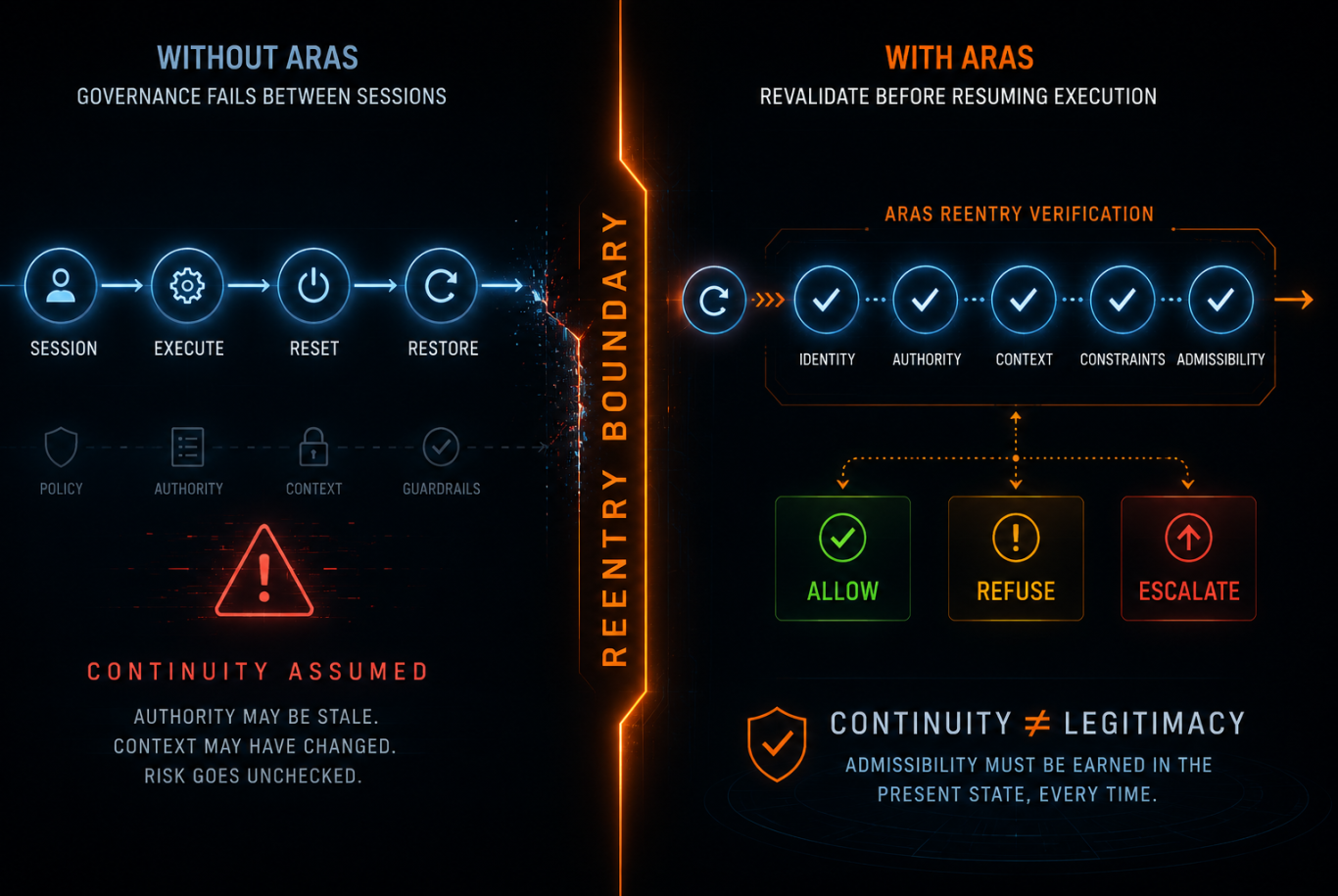
The Purpose Behind ARAS
Most governance failures occur during continuity — not inside a session, but between them.
Autonomous and agentic systems increasingly operate across resets, handoffs, orchestration layers, delegated execution, and persistent workflows. Yet most governance models evaluate actions inside active sessions while treating continuity itself as implicitly trustworthy.
ARAS™ (Agentic Reentry & Admissibility Standard) was created to address this governance gap.
ARAS ensures continuity never silently substitutes for legitimacy. At every reentry boundary, present-state admissibility must be independently re-established before consequence-bearing actions proceed.
This includes revalidation of:
- Identity — Is the acting system still the authorized entity?
- Authority — Do permissions remain current and valid?
- Context — Has operational context changed?
- Constraints — Do present-state boundaries still apply?
- Admissibility — Should execution proceed, refuse, or escalate?
Because preserved continuity is not the same as valid authority.
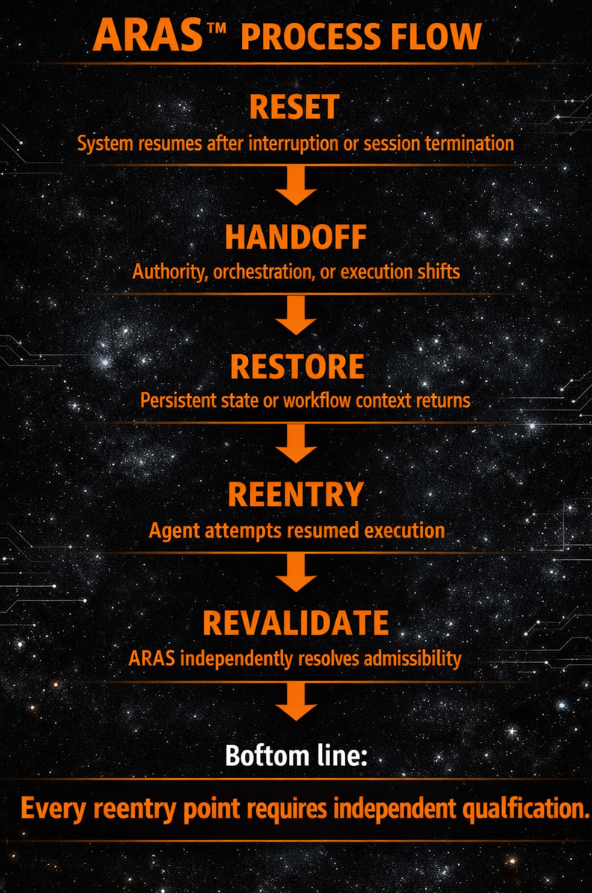
Most Governance Failures Happen Between Sessions
Enhancing Efficiency and Lawful Actions
Traditional AI governance focuses on policies, monitoring, outputs, and post-event review. But autonomous and agentic systems increasingly persist across:
✓ Session restoration
✓ Orchestration handoffs
✓ Delegated execution
✓ Memory continuity
✓ Long-running workflows
The governance question is no longer only:
Was the action valid when first authorized?
It is also:
Is the action still admissible now?
ARAS™ addresses failures that emerge between execution states - where preserved continuity risks being mistaken for present-state legitimacy.
Because continuity alone cannot confer authority.
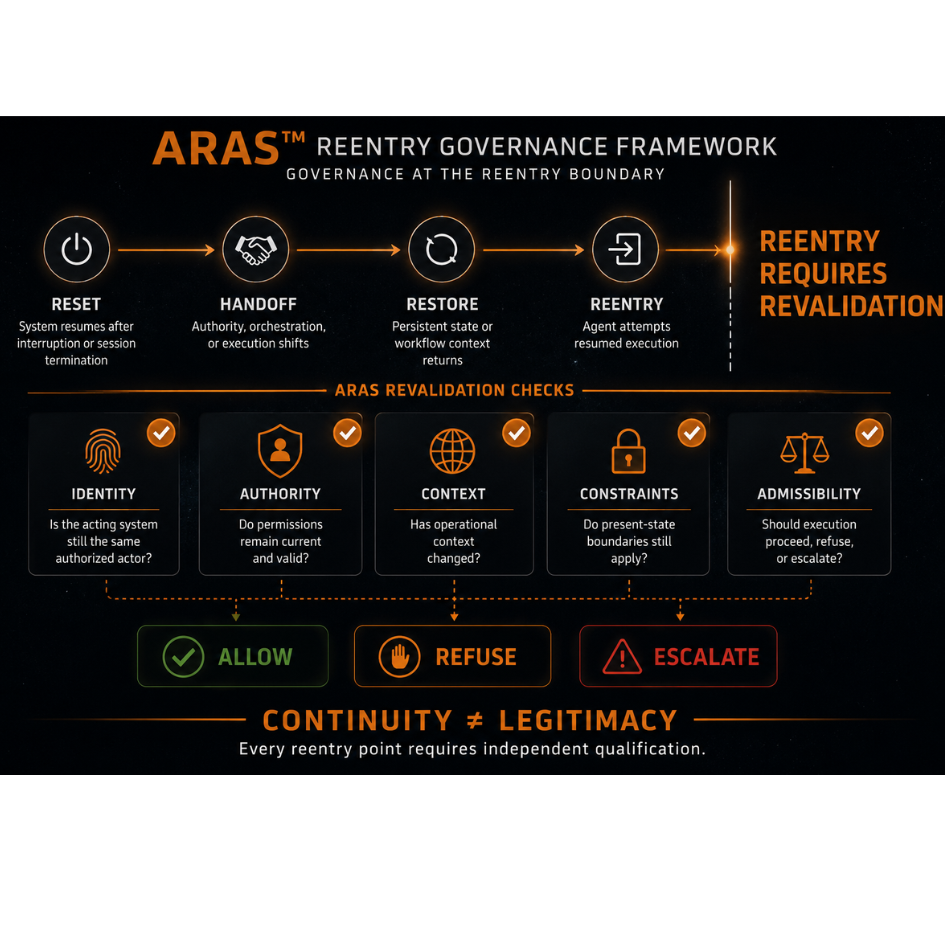
Governance at the Reentry Process
Continuity ≠ Legitimacy
ARAS governs the moment autonomous and agentic systems resume operation after resets, handoffs, restored workflows, or orchestration changes.
Continuity alone is insufficient.
Before execution resumes, ARAS independently verifies identity, authority, operational context, constraints, and present-state admissibility.
Only then can execution proceed, refuse, or escalate.
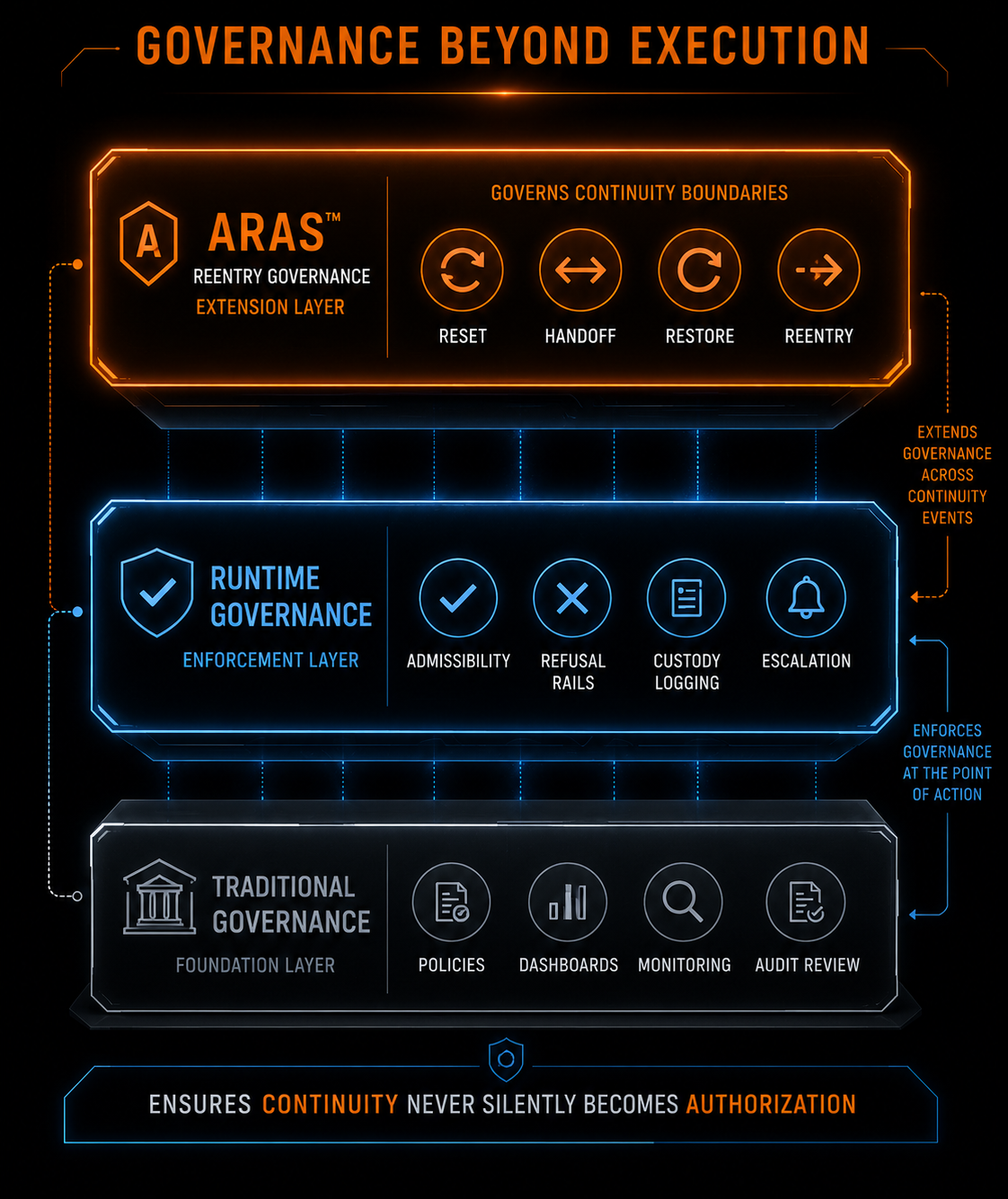
How ARAS Extends Existing Governance
Governance Beyond the Decision Moment
Most governance frameworks are designed to evaluate AI systems during execution or after consequence occurs.
ARAS extends governance into the moments many systems implicitly trust:
✓ Session restoration
✓ Orchestration handoffs
✓ Delegated execution recovery
✓ Persistent workflow continuation
✓ Multi-session agent reentry
Traditional Governance
✓ Policies
✓ Dashboards
✓ Monitoring
✓ Post-event review
✓ Audit reconstruction
Runtime Governance
✓ Admissibility at execution
✓ Refusal rails
✓ Custody enforcement
✓ Human escalation controls
✓ Replay-verifiable oversight
The ARAS Layer
Governance at the reentry boundary
ARAS independently determines whether resumed execution remains admissible under present-state conditions.
Because continuity alone cannot confer authority.
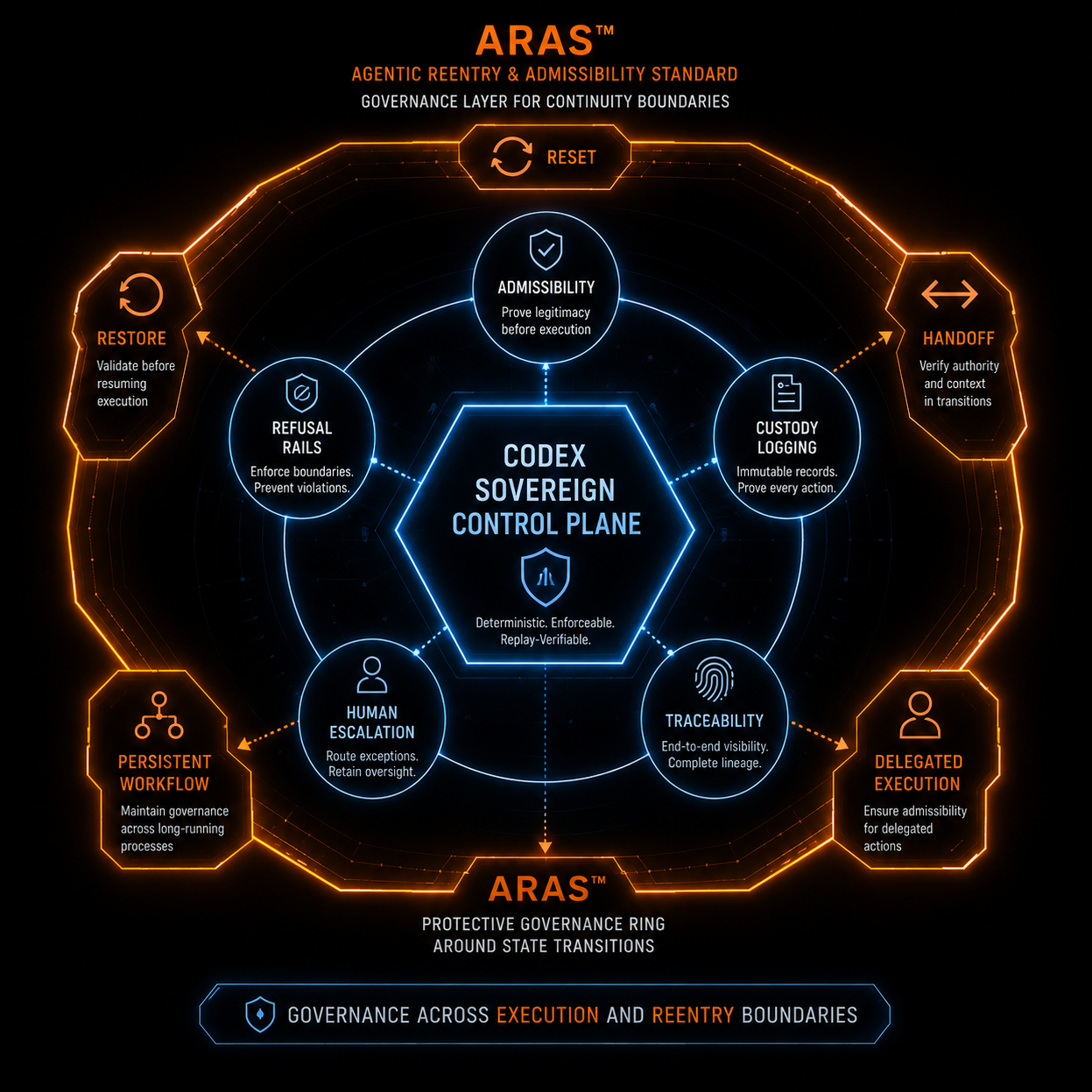
ARAS in the Codex Sovereign Architecture
Where Reentry Governance Fits
ARAS™ is a formal runtime governance layer within the broader Codex Sovereign™ architecture.
Codex Sovereign governs consequence-bearing execution through admissibility, refusal rails, custody enforcement, and replay-verifiable oversight.
ARAS extends those protections to one of the most overlooked risk surfaces in autonomous and agentic systems:
reentry.
When systems resume after resets, orchestration handoffs, restored workflows, delegated execution, or persistent state recovery, prior authorization alone may no longer be sufficient.
ARAS ensures that continuity never silently becomes legitimacy.
Instead of assuming preserved state remains valid, ARAS independently re-establishes admissibility under present-state conditions before execution resumes.
Core Protections
✓ Reentry qualification
✓ Identity and authority revalidation
✓ Continuity-risk detection
✓ Delegated execution safeguards
✓ Escalation and refusal boundaries
✓ Replay-verifiable custody
✓ Present-state admissibility enforcement
Governance Principle
Continuity may support replayability and inspection.
It cannot substitute for legitimacy.
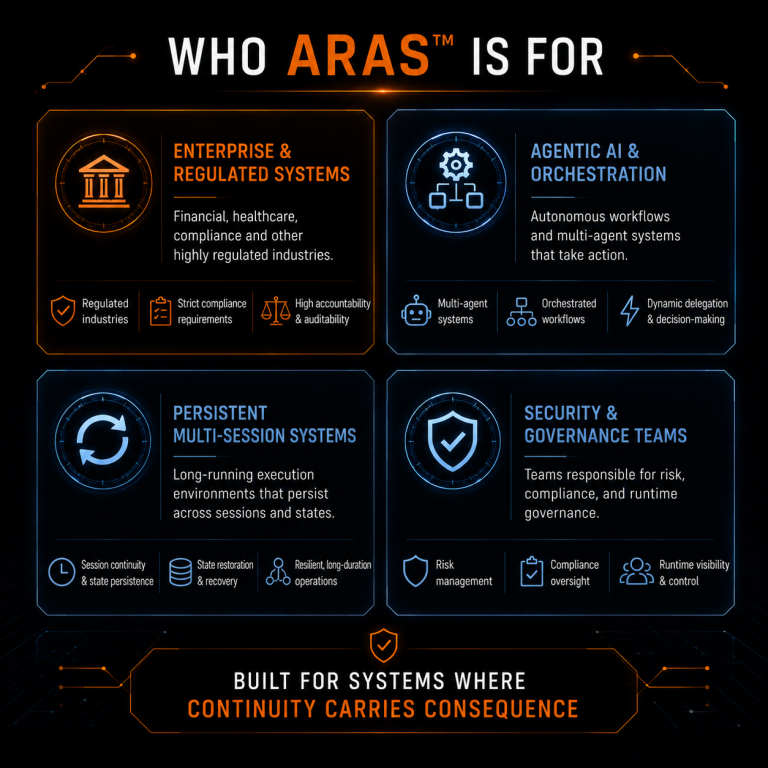
Who ARAS Is For
Built for organizations operating consequence-bearing AI systems
ARAS is designed for teams managing autonomous or agentic systems operating across:
✓ Multi-session workflows
✓ Orchestration and handoff environments
✓ Delegated execution chains
✓ Persistent memory systems
✓ High-risk or regulated operations
✓ Runtime governance and audit requirements
Typical stakeholders include:
- AI governance teams
- Risk and compliance leaders
- Enterprise AI architects
- Responsible AI programs
- Security and operational assurance teams
- Organizations preparing for EU AI Act obligations