

Vayo Financial – Sample 60-Day
Executive Governance Audit
Typical Engagement Profile
Duration: 60 days
Executive Time Commitment: Approximately 6-10 hours across the engagement
Primary Participants: Risk, Compliance, Audit, Technology, and Operations leadership
Primary Output: Board-ready governance assessment and roadmap
Executive Summary
Company: Vayo Financial | Date: May 2026
Overall Governance Posture: Yellow (Moderate Risk)
While Vayo Financial had strong foundational policies, the audit revealed critical runtime gaps, including agentic payment routing bypasses, inconsistent refusal rail enforcement, and weak custody logging.
Red Flags Identified
- High Risk: Agentic payment routing allows historical approvals to bypass current risk posture (ARAS-3 violation)
- Medium Risk: No mandatory revalidation on session restoration for underwriting decisions
- Medium Risk: Human oversight exists on paper but lacks operational enforceability at decision boundaries
Prioritized 90-Day Implementation Roadmap
(Delivered at the end of the 60-Day Audit)
Tagline
Executive Commitment
The 60-Day Executive Governance Audit does not require sixty days of executive involvement.
The sixty-day period reflects the structured assessment window required to evaluate governance across people, processes, systems, workflows, and evidence chains.
Typical executive participation includes:
- Initial scoping session (60-90 minutes)
- Selected stakeholder interviews
- One governance workshop
- Interim findings review
- Final executive presentation
Most evidence is gathered from existing documentation, operational artifacts, and targeted stakeholder discussions.

What You Receive
This audit delivers more than a report. You receive board-ready evidence of your actual runtime governance posture - including scoring, regulatory mapping, real governance artifacts, and a prioritized execution plan that turns diagnosis into measurable improvement.
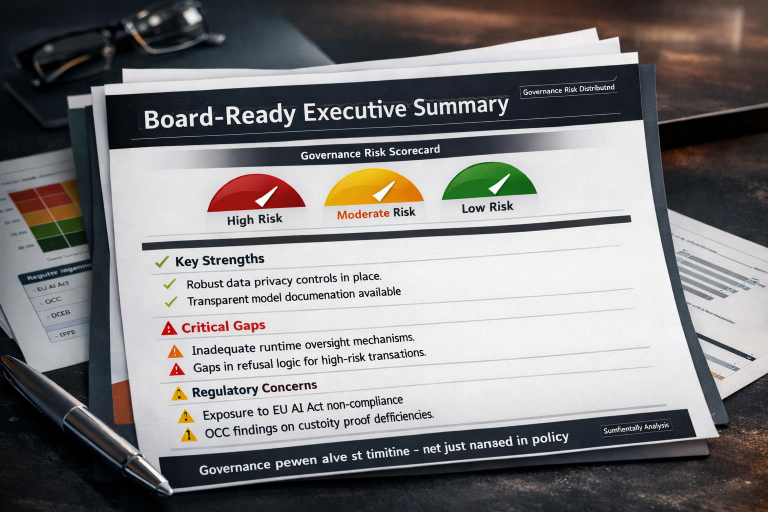
Board-Ready Executive Summary
A concise 2–3 page overview with a scoring dashboard (Red/Yellow/Green) across governance domains.
It highlights strengths, critical gaps, and regulatory exposure in language tailored for boards and regulators.
This summary is designed to be presentation‑ready, giving executives a clear picture of risk posture without technical overload.
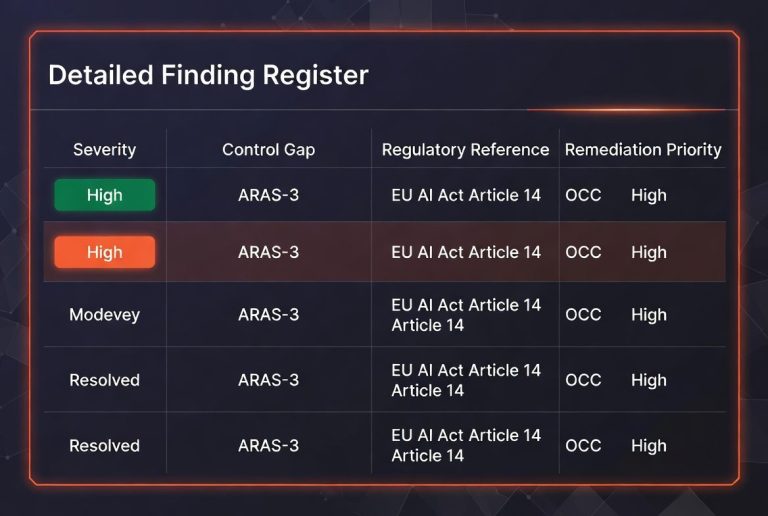
Detailed Finding Register
A structured register of all findings, mapped directly to EU AI Act articles, OCC exam expectations, and CFPB oversight criteria.
Each entry includes severity, regulatory relevance, and remediation priority.
This register becomes the backbone of compliance responses, ensuring every gap is tied to a specific regulatory obligation.
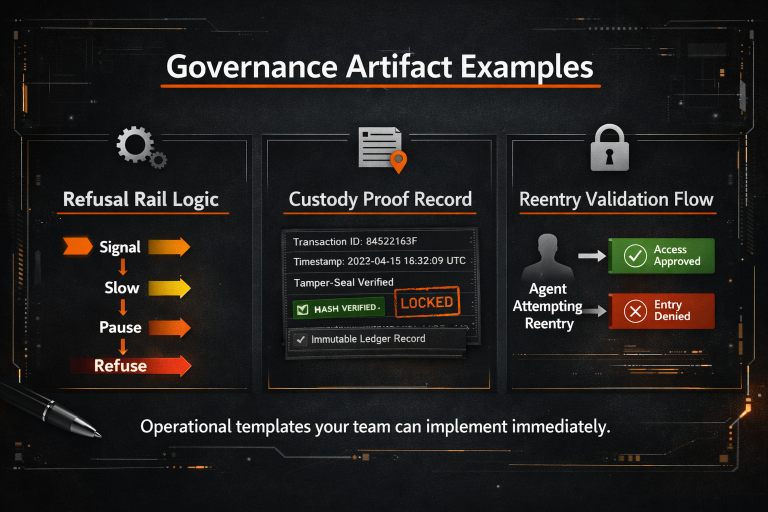
Governance Artifact Examples
Engagement of all stakeholders is critical in governance improvement. The Prioritized 90-Day Action Plan encourages collaboration, ensuring all parties are invested in the governance process. By working together, organizations can leverage diverse insights to foster a more robust governance structure.
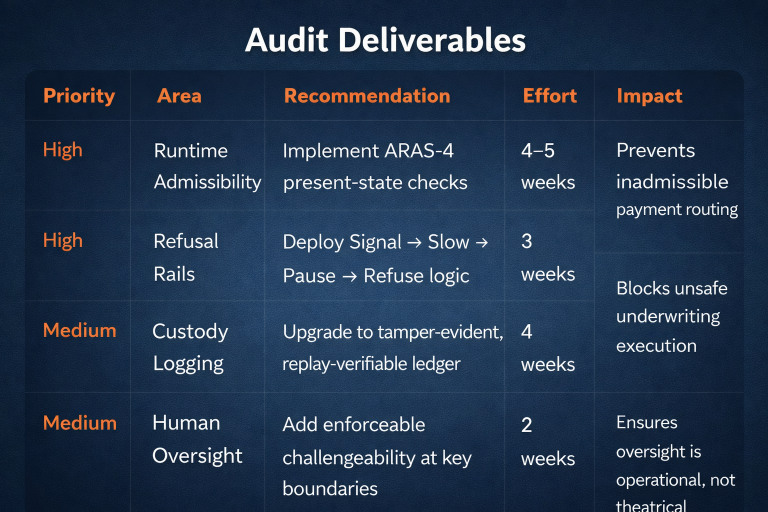
90-Day Execution Roadmap
A prioritized plan with clear owners, timelines, and success metrics. Each recommendation is tied to impact (e.g., “prevents inadmissible payment routing” or “strengthens audit‑ready legitimacy”). This roadmap ensures the audit doesn’t stop at findings — it drives execution, accountability, and measurable improvement.
Questions This Audit Answers
- Can our AI systems execute actions that would not be authorized under current conditions?
- Where do authority, oversight, or governance controls break down?
- Are our controls enforceable at runtime or merely documented?
- Can we demonstrate governance effectiveness to regulators, auditors, and boards?
- What should we prioritize over the next 90 days?

What makes this audit different:
The 60-Day Executive Governance Audit identifies where AI systems may continue operating after authority, oversight, or risk conditions have changed.
Runtime enforcement - not just policy review:
(refusal rails, custody proof, admissibility at the decision boundary)
- Produces replay‑verifiable artifacts regulators increasingly expect
- Includes ARAS analysis for modern agentic systems
- Delivers a prioritized 90‑day action plan with clear ownership and success metrics.
Identify runtime governance failures before they become operational, regulatory, or reputational events.
Who This Audit Is Designed For
Organizations:
✓ Deploying or scaling AI systems
✓ Preparing for EU AI Act compliance
✓ Operating in regulated environments
✓ Using copilots, agents, or workflow automation
✓ Seeking board-level assurance
✓ Concerned about runtime accountability and evidentiary gaps
Typical stakeholders:
- Chief Risk Officers
- Chief Compliance Officers
- Chief Audit Executives
- Chief AI Officers
- CIOs and CTOs
- Board Risk Committees


Outcomes
Organizations gain:
- Clear accountability for consequential decisions
- Reduced evidence reconstruction burden
- Increased regulatory readiness
- Greater board confidence
- Improved decision traceability
- Stronger operational legitimacy
- Enhanced audit and investigation preparedness