Runtime Admissibility:
The New Standard for AI Governance
Runtime Admissibility: The New Standard for AI Governance
White Paper — Version 1.0 — August 2026
Runtime Admissibility:
The New Standard for AI Governance
White Paper — Version 1.0 — August 2026
Kristina Vayo – Codex Sovereign™
Runtime Admissibility
As AI systems transition from advisory tools to autonomous decision-makers, traditional governance is reaching its breaking point.
Static policies, design-time controls, and retrospective audits can no longer guarantee legitimacy when decisions carry real-world consequences.
Runtime Governance is emerging as a necessary operational discipline for agentic and autonomous systems, shifting governance from documentation and oversight toward enforceable decision-bound controls.
Runtime Admissibility is the new standard for Runtime Governance: the enforceable guarantee that every consequential action was legitimate at the exact moment it was executed; not merely planned, approved, or documented beforehand.
Runtime Admissibility is the continuous determination of whether a consequential action remains legitimate under present conditions at the moment execution occurs.
This white paper defines the concept, explains why traditional governance fails under autonomy, and establishes custody proof as the operational foundation for defensible AI systems capable of proving legitimacy at the moment consequence attaches.
1. The Failure of Static Governance
Traditional AI governance relies on three fragile assumptions:
- Policies written in advance will remain relevant
- Human oversight can reliably intervene before consequence forms
- Audit logs will be sufficient to reconstruct intent and legitimacy
These assumptions collapse as systems become more autonomous, distributed, and fast-moving. An AI system can have:
- Approved policies
- Completed risk assessments
- Comprehensive audit trails
- Human oversight procedures
…and still execute decisions that were not admissible under the actual conditions at the time of execution.
These assumptions begin to fail because authority, evidence, environmental conditions, and consequence boundaries may change continuously during execution while governance artifacts remain static.
This creates a dangerous gap:
Policy ≠ Enforcement.
Documentation ≠ Legitimacy.
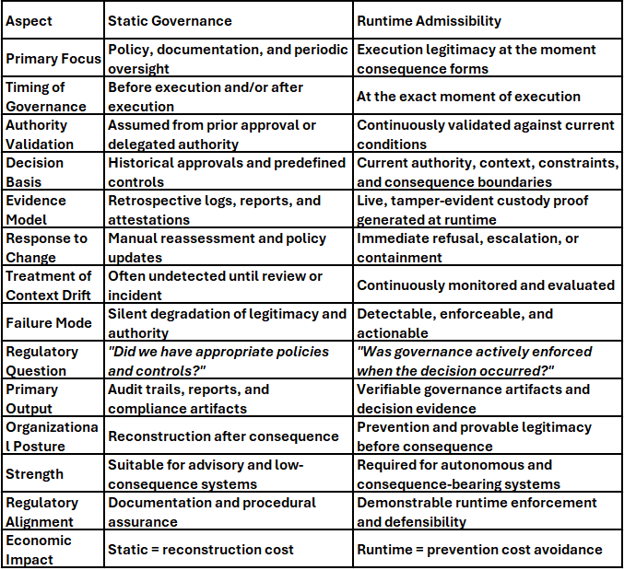
2. Static Governance vs. Runtime Admissibility
Concrete Examples
Example 1: AI-Powered Lending Decision (Financial Services)
A digital lender uses an AI underwriting model. Six weeks ago, a loan officer was granted authority to approve loans up to $250,000. Since then, the officer has moved to a different department, but the system was never updated.
Static Governance Outcome:
The system logs the decision, shows the original approval policy, and produces a complete audit trail. Everything looks compliant.
Runtime Reality:
At the moment the $180,000 loan was approved, the person who supposedly authorized it no longer held that authority. The decision was inadmissible.
Without runtime admissibility, the organization cannot prove the decision was legitimate when it occurred; creating regulatory, legal, and reputational risk.
Example 2: Healthcare Triage Agent
An AI triage agent in an emergency department flags a patient as “low risk” based on symptoms entered 40 minutes earlier. During that interval, new lab results became available indicating early sepsis.
Static Governance Outcome:
The system followed its approved protocol and logged the recommendation.
Runtime Reality:
The agent executed on stale context. A runtime admissibility check would have detected the new evidence, triggered a refusal or escalation to a physician, and generated a custody artifact showing why the original recommendation was blocked.
These examples illustrate why assessment is not enough. Organizations need the ability to prove legitimacy at bind time, not just reconstruct it afterward.
3. Defining Runtime Admissibility
Runtime Admissibility is the structural property of a governance system that ensures every consequence-bearing action is explicitly authorized, contextually valid, and demonstrably legitimate at the moment consequence is created.
It answers five critical questions in real time:
- Who (or what) holds authority right now?
- Is this action admissible under current conditions?
- Are all required constraints and controls active?
- Has authority silently degraded since last validation?
- Can this decision be defended with tamper-evident evidence?
- Has any material change occurred that invalidates previously granted authority?
If any answer is “no” or “unknown,” the action must be refused, slowed, or escalated - before consequence binds.
4. Architecture Diagram
Decision Request
↓
Authority Verification
↓
Constraint Validation
↓
Evidence Freshness Check
↓
Admissibility Evaluation
- Supports EU AI Act Article 14 (Human Oversight)
↓
┌──────────────┬──────────────┐
│ ADMISSIBLE │ NOT ADMISSIBLE │
└──────────────┴──────────────┘
Execute Refuse / Escalate
↓
Generate Custody Proof
↓
Ledger / Governance Artifact
5. Custody Proof vs. Audit Logs
Custody Proof is Not Audit Logging
Traditional audit logs describe what occurred. Custody Proof establishes whether execution was legitimate before consequence was allowed to form.
Custody Proof establishes whether execution was legitimate before consequence was allowed to form.
Audit logs narrate history.
Custody Proof governs execution.
It is a live, tamper-evident assertion that:
- Authority was valid and current
- All governance invariants were satisfied
- The decision context was complete and admissible
- Execution remained within defined boundaries
- The legitimacy basis cannot be established solely through retroactive reconstruction
True custody proof must be:
- Generated at the decision boundary
- Cryptographically bound to the moment of execution
- Independently verifiable (replayable)
- Resistant to silent degradation or retroactive justification
Without custody proof, organizations are left with reconstruction; an expensive, uncertain, and increasingly indefensible practice.
6. Why Runtime Evidence Is Now the Standard
- AI systems are moving from suggestion to execution
- Regulatory regimes (EU AI Act, emerging U.S. frameworks) are demanding demonstrable oversight at the point of action
- Autonomous and agentic systems create long-duration and cross-session decision chains where authority, evidence freshness, and admissibility may silently degrade.
- Workflow suspension and re-entry invalidate previously granted authority.
- The cost of governance failure is shifting from technical to existential (organizational legitimacy)
- Organizations increasingly face scrutiny that requires independent reconstruction and defense of consequential decisions months or years after execution.
Static documentation was acceptable when AI was advisory.
It is insufficient now that AI is operational.
7. Regulatory Alignment: How Runtime Admissibility Supports the EU AI Act
Runtime Admissibility is not an alternative to regulatory compliance; it is the operational mechanism that makes compliance demonstrable in practice.
The EU AI Act places significant emphasis on high-risk AI systems through several key articles that Runtime Admissibility directly operationalizes:
- Article 12 (Record-keeping) requires automatic logging of events to ensure traceability. Runtime Admissibility goes further by generating tamper-evident custody proof at the moment of execution, producing logs that are not only complete but also admissible and replay-verifiable.
- Article 14 (Human Oversight) mandates that high-risk systems be designed to allow effective human oversight. Runtime Admissibility enforces this by requiring meaningful intervention points (refusal, escalation, or challenge-ability) at the decision boundary, rather than relying on after-the-fact review.
- Article 9 (Risk Management System) and Article 15 (Accuracy, Robustness and Cybersecurity) demand continuous risk mitigation throughout the system lifecycle. Runtime Admissibility provides the real-time mechanism to detect when authority, evidence freshness, or constraints have degraded, triggering refusal or escalation before harm occurs.
By implementing Runtime Admissibility, organizations move beyond checkbox compliance. They create provable, enforceable governance that regulators can verify; not just policies that claim oversight exists, but technical evidence that it was actively maintained at the point of decision.
8. Failure Modes of Non-Admissible Systems
Systems become inadmissible when:
- Authority is revoked or expires.
- New evidence materially alters the decision basis.
- Policies or regulations change.
- Required controls become unavailable.
- Decision scope expands beyond approved boundaries.
- Model behavior materially changes.
- Identity or delegation chains cannot be verified.
- Environmental or threat conditions change.
- Consequence severity exceeds approved thresholds.
9. Runtime Admissibility States
Runtime Admissibility is not binary. Systems may transition through multiple governance states as authority, evidence, constraints, and environmental conditions evolve.
Examples:
- Admissible — all authority, evidence, and constraints remain valid.
- Degraded — legitimacy remains provisionally intact, but one or more governance conditions have weakened.
- Unknown — legitimacy cannot be established with sufficient confidence.
- Denied — execution is prohibited.
- Recovery — remediation or requalification activities are underway.
10. Operationalizing Runtime Admissibility
Organizations seeking to implement Runtime Admissibility require:
- Continuous authority validation
- Runtime constraint enforcement
- Evidence freshness assessment
- Refusal and escalation mechanisms
- Custody Proof generation
- Tamper-evident governance artifacts
Codex Sovereign operationalizes these capabilities through deterministic runtime governance, enforceable refusal rails, and verifiable custody infrastructure.
11. Runtime Admissibility Complements Existing Frameworks
Existing governance frameworks such as NIST AI RMF, ISO/IEC 42001, and regulatory regimes like the EU AI Act establish important requirements for risk management, oversight, transparency, and accountability.
Runtime Admissibility does not replace these frameworks. It operationalizes them at execution time by continuously evaluating whether consequential actions remain legitimate under present conditions.
12. Next Steps / Call to Action
This document establishes Runtime Admissibility and Custody Proof as foundational requirements for responsible autonomous AI.
Organizations deploying autonomous, agentic, or high-consequence AI systems should begin evaluating whether their existing governance capabilities can:
- Continuously validate authority at runtime
- Detect when admissibility conditions have changed
- Enforce refusal, escalation, and containment when legitimacy fails
- Generate verifiable, tamper-evident decision evidence at the moment consequence forms
- Demonstrate governance under regulatory, legal, and operational scrutiny
As AI systems become increasingly autonomous, organizations that cannot prove runtime legitimacy may find themselves forced to reconstruct it after the fact.
The question facing organizations is no longer whether AI governance exists, but whether governance can be proven when consequential decisions are challenged.
Organizations that cannot demonstrate runtime legitimacy risk regulatory exposure, operational disruption, and loss of institutional trust.
Codex Sovereign was built to operationalize these capabilities through deterministic runtime governance, enforceable refusal rails, and verifiable custody infrastructure.
To learn more, visit codexsovereign.org or contact us to discuss your organization's runtime governance posture.
Governance that cannot be proven at runtime cannot be reliably defended after consequence occurs.
Runtime Admissibility Page Index
1. The Failure of Static Governance
2. Static Governance vs. Runtime Admissibility
3. Defining Runtime Admissibility
4. Architecture Diagram
5. Custody Proof vs. Audit Logs
6. Why Runtime Evidence Is Now the Standard
7. Regulatory Alignment: How Runtime Admissibility Supports the EU AI Act
8. Failure Modes of Non-Admissible Systems
9. Runtime Admissibility States
10. Operationalizing Runtime Admissibility
11. Runtime Admissibility Complements Existing Frameworks
© 2026 Kristina Vayo / Codex Sovereign™. All rights reserved.
Runtime governance architecture supported by associated provisional patent applications.