
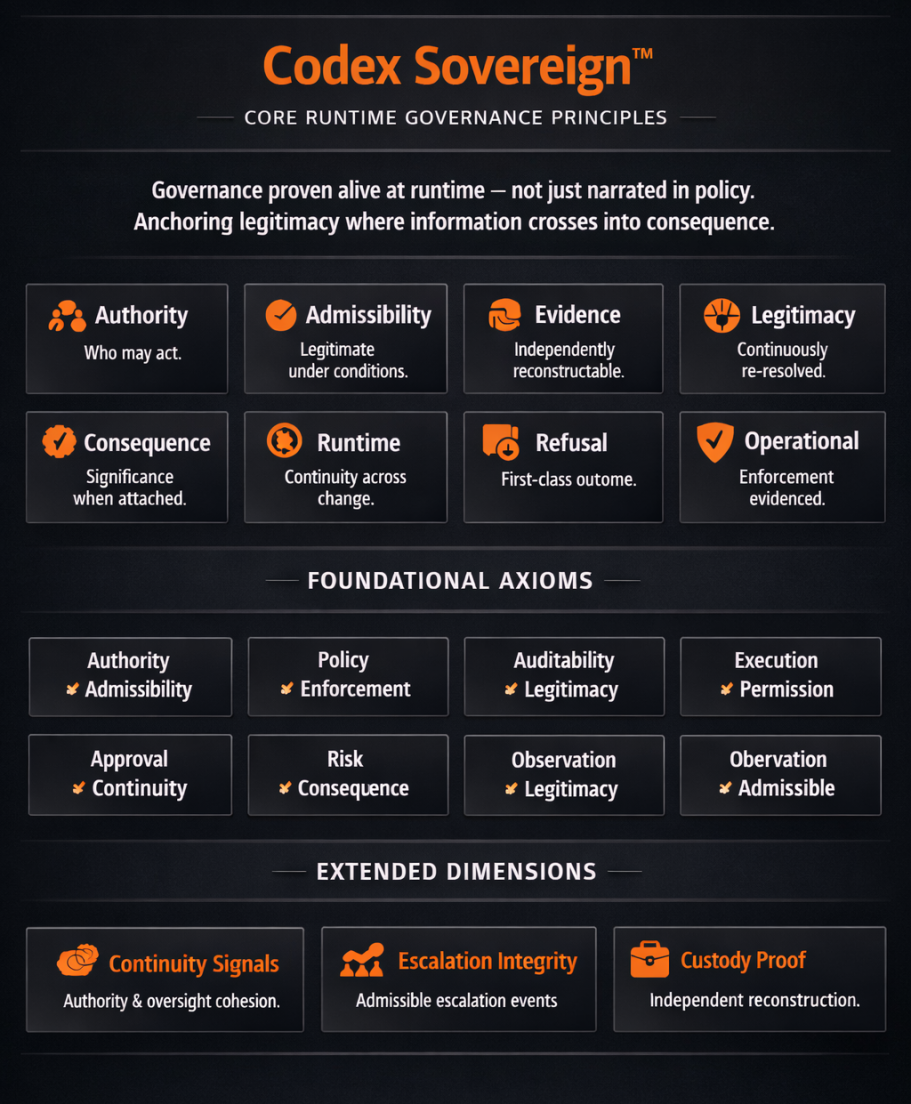
Codex Sovereign™
Core Runtime Governance Principles
Governance proven valid at runtime — not just narrated in policy.
Codex Sovereign anchors legitimacy where it matters most: at the moment information crosses into consequence.

Core Principles
The Core Runtime Governance Principles define how legitimacy is preserved when AI systems act in consequential contexts. They establish authority, admissibility, evidence, and refusal as operational controls that must be enforced at runtime, not just documented at design time. By anchoring governance to the moment consequence attaches, these principles ensure that oversight, accountability, and continuity remain valid across changing conditions.
- Authority establishes who may act. Defines the right to initiate, delegate, approve, or influence consequential action.
- Admissibility determines whether action remains legitimate under present conditions. A previously authorized action may become inadmissible as context, policy, oversight, or environmental conditions change.
- Evidence preserves whether governance determinations can later be independently reconstructed. Enables replay, challenge, audit, and verification of governance decisions after consequence has formed.
- Legitimacy must be continuously re‑resolved at consequential bind points. Governance cannot rely solely on design‑time approval. Legitimacy must be re‑evaluated whenever information crosses into consequence.
- Consequence significance changes when outputs bind to reality. Reasoning, planning, and recommendation may occur continuously, but governance intensifies when outputs produce real‑world effects.
- Runtime governance preserves legitimacy continuity across changing conditions. Ensures authority, oversight, policy applicability, and environmental assumptions remain valid throughout execution.
- Refusal is a first‑class governance outcome. When admissibility cannot be established, systems must be capable of holding, escalating, pausing, or refusing execution.
- Operational enforcement defines governance as real. Policies, documentation, and approvals are insufficient unless enforcement can be evidenced at the moment consequence attaches.
Foundational Axioms & Extended Dimensions
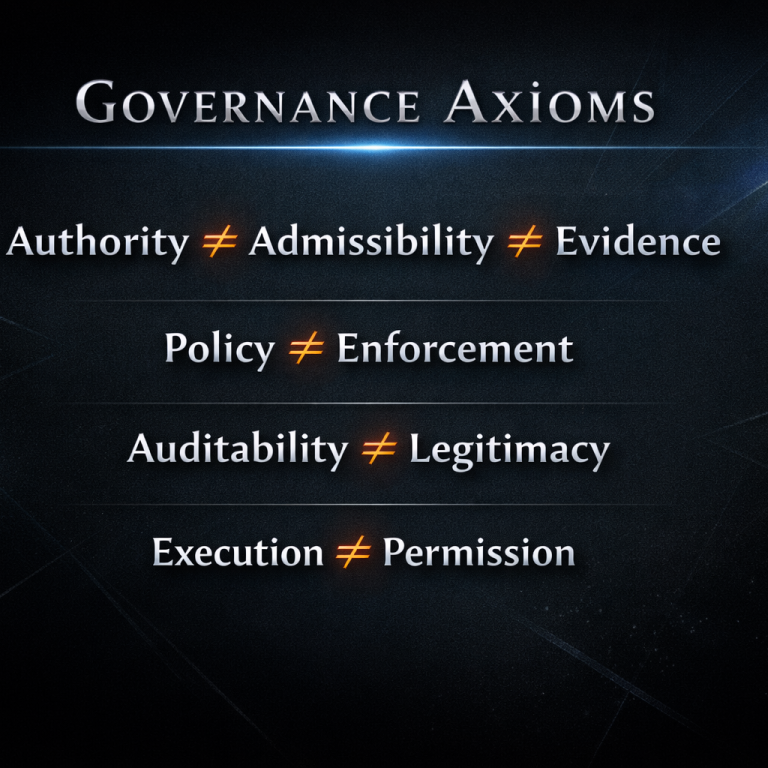
The Foundational Axioms & Extended Dimensions anchor Codex Sovereign™ in principles that cannot be bypassed. The axioms establish non‑negotiable distinctions—authority ≠ admissibility, policy ≠ enforcement, auditability ≠ legitimacy—while the extended dimensions expand governance into continuity signals, escalation integrity, and custody proof. Together, they ensure governance is not abstract theory but operational reality, capable of holding legitimacy across shifting conditions.
Foundational Axioms
- Authority ≠ Admissibility ≠ Evidence
- Policy ≠ Enforcement
- Auditability ≠ Legitimacy
- Execution ≠ Permission
- Approval is not continuity
- Governance significance changes when consequence attaches
- Legitimacy must be continuously re‑resolved
- Refusal is a valid governance outcome
- Risk classification ≠ Consequence alignment
- Observation ≠ Legitimacy
- Escalation must be admissible
Extended Dimensions
- Continuity signals → Prove authority and oversight continuity across shifting conditions.
- Escalation integrity → Ensure escalation events themselves are admissible.
- Custody proof → Distinguish governance from observation by enabling independent reconstruction.