
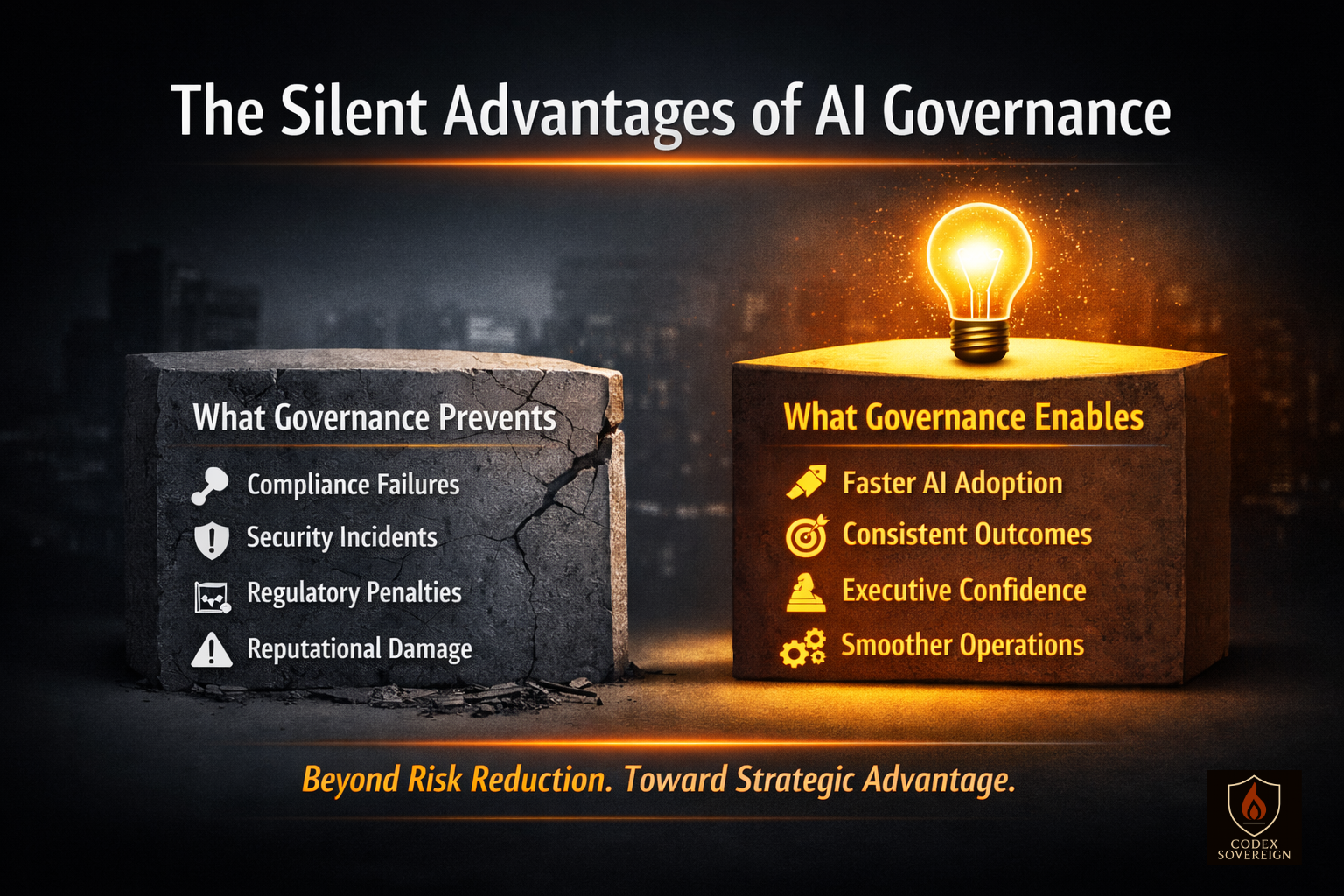
The Hidden Advantages of AI Governance
For many organizations, AI governance is viewed primarily as a defensive exercise — something required by regulators, auditors, or risk teams.
But well‑designed governance creates operational advantages that often go unnoticed precisely because it prevents problems before they become visible. The greatest value of governance is often measured by the crises that never occur.
Governance Creates Clarity
Before organizations can govern AI, they must first understand it.
Developing an AI inventory forces teams to answer questions many have never formally asked:
- Where is AI actually being used?
- Who owns each system?
- What business decisions depend on it?
- What level of risk does it introduce?
These questions often uncover shadow AI, duplicate tools, and inconsistent practices long before they create issues. The inventory itself becomes a strategic asset — a map of where AI lives and who is accountable for it.
Governance Accelerates Adoption
Contrary to popular belief, strong governance frequently speeds up AI deployment.
When ownership, review processes, and escalation paths already exist, new initiatives can move forward with confidence instead of rebuilding governance from scratch.
Governance doesn’t slow innovation — it removes hesitation.
Governance Builds Executive Confidence
Executives rarely ask whether the AI is intelligent. They ask whether they can trust it.
That trust comes from visibility, accountability, and evidence — not just model performance.
Governance provides the assurance that systems are understood, monitored, and authorized — giving leaders confidence to expand AI into higher‑stakes workflows.
Governance Detects Problems Before Customers Do
One of the least appreciated advantages of AI governance is its ability to identify when a system is no longer operating as expected.
Governance isn’t only about approval before deployment — it’s about maintaining confidence after deployment.
As AI systems evolve, they may experience:
- model drift as operating conditions change
- data drift as inputs differ from those used during development
- hallucinations that reduce reliability
- degradation as workloads increase
- changing regulatory or policy requirements that affect permissible operation
Without governance, these changes often remain invisible until customers, employees, or auditors discover them first.
Mature governance establishes review criteria, monitoring expectations, escalation paths, and ownership so organizations can detect emerging issues before they become operational failures.
Governance Makes Audits Easier
Organizations with mature governance don’t scramble when auditors arrive.
Evidence, ownership records, and review histories already exist. The audit becomes a demonstration rather than a reconstruction.
The Runtime Advantage
Governance doesn’t end at deployment. It continues at runtime — where decisions actually occur.
As AI becomes more autonomous, governance must evolve from documentation to operational capability. Runtime governance verifies that consequential actions remain authorized under current conditions, while ongoing processes identify when models, data, or policies have changed enough to require review, recalibration, or renewed authorization.
The Quiet Return on Investment
The best governance programs are rarely the most visible.
They simply become part of how the organization operates: clear ownership, consistent processes, available evidence, and confidence to scale responsibly.
Mature governance doesn’t just detect technical change — it identifies when the assumptions under which an AI system was approved are no longer true.
A model may continue producing outputs, but changes in policy, regulation, business objectives, or data quality may require governance to reassess whether continued operation remains appropriate.
Governance doesn’t just prevent failure. It creates the operational confidence that allows innovation to scale with integrity.