
Refusal Rails: The Enforceable Boundary in AI Governance
Introduction: Why Refusal Rails Matter
AI adoption is accelerating, but governance maturity lags behind. Most organizations can document decisions, but few can prove that governance was alive at the exact moment execution occurred. The real risk isn’t what the model outputs - it’s whether execution proceeds when legitimacy is uncertain, stale, or degraded.
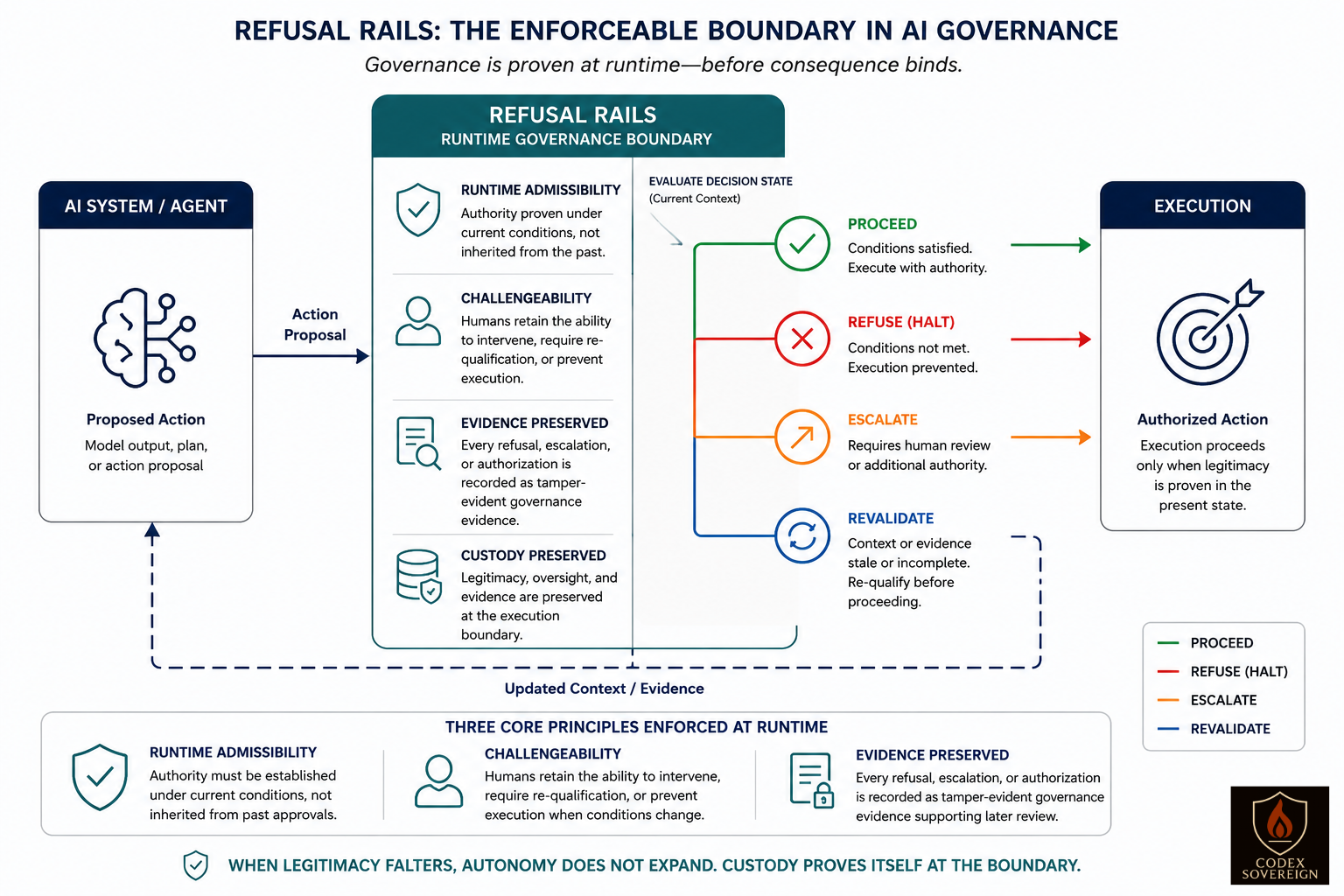
Refusal rails are the missing infrastructure. They are enforceable runtime boundaries that preserve custody, legitimacy, and human oversight when execution conditions fail.
Section 1: The Risk Beyond Outputs
Bad outputs can be corrected. The deeper risk is execution without authority, oversight, or valid constraints.
- In financial systems, a stale authorization can trigger trades that violate compliance.
- In medical AI, outdated oversight can allow treatment recommendations without current validation.
- In persuasive media, degraded legitimacy can spread influence without custody proof.
Refusal rails address this directly: when conditions fail, they trigger halt, escalate, or revalidate before consequence binds. Escalation pathways ensure governance continuity, not just interruption.
Section 2: What Refusal Rails Do
Refusal rails are not passive safeguards. They are active enforcement mechanisms:
- Halt execution when legitimacy collapses.
- Escalate to human oversight when conditions degrade.
- Revalidate authority before proceeding.
This ensures that governance remains operational, not just procedural.
Section 3: Principles in Depth
At their core, refusal rails enforce four principles:
- Runtime Admissibility — authority must be proven under current conditions, not inherited from the past.
- Challengeability — humans retain the ability to intervene, require re‑qualification, or prevent execution.
- Evidence Preservation — every refusal, escalation, or authorization is recorded as tamper‑evident governance evidence.
- Non‑bypassable Boundary — execution is technically impossible unless authority, oversight, and custody proof are validated at runtime.
Refusal is not failure. It is runtime enforcement — proof that governance remained active when execution could no longer be justified.
Section 4: From Policy to Infrastructure
Frameworks like the EU AI Act and NIST AI RMF demand oversight, traceability, and robustness. But policies alone are aspirational.
Refusal rails operationalize those obligations:
- Turning oversight into runtime enforcement.
- Turning traceability into custody chains.
- Turning robustness into non‑bypassable execution boundaries.
This is where governance moves from paper to infrastructure.
Conclusion: Custody at the Boundary
When legitimacy falters, autonomy does not expand. Custody proves itself at the boundary.
Refusal rails are not about slowing AI down — they are about making scale survivable. They ensure that governance remains alive at the exact moment consequence binds, transforming compliance from a checklist into operational capability.